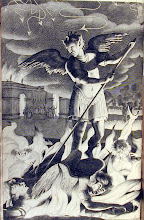
As came up in class discussion today, Milton's relationship to the pagan world can seem puzzling. On the one hand, "On the Morning of Christ's Nativity" seems most certainly to be the poem of a devout Christian, meditating on a central mystery of the Christian faith, the Incarnation. In his Latin Elegy 7, written to his friend Charles Diodati around December 1629, Milton says that he is composing a birthday gift for Christ. This is one Christian poet writing to another devout young man.
On the other hand, the same elegy refers (in Latin) to the baby Jesus as the "peace-bearing king of heavenly race," almost as if he might be one of a pantheon of gods. The association is all the easier to make, as this description of Jesus as a "king of heavenly race" occurs immediately after Milton's thoughts on the sacred vocation of the poet: "Truly the bard is sacred to the gods; he is their priest, and both his heart and lips mysteriously breathe the indwelling Jove." (Truly JM? Do you mean that the pagan Roman god Jove dwells within you, or do you mean Jehovah?)
The Nativity Ode's image of the infant Jesus strangling the pagan snake gods just like the infant Hercules reinforces this striking representation of the Christian Messiah. He doesn't just replace the pagan gods or show that they don't count or were never real: baby Jesus subdues them, makes them his victims, giving them a reality on the same plane as his own. And in the process, the poet shows just how deeply immersed he is in details of the ancient pagan cults -- with the lars, lemures, and flamens of Roman religion (stanza XXI), or the ceremonies of the cult of Osiris (XXIV).
Because he chose to be a Christian poet and not a Christian priest, Milton can -- in his learnedly allusive figurative language -- play with the expressive possibilities of syncretism, which is the attempt to reconcile two different, even conflicting, systems of belief and thought. This is what he does too with the image of the shepherd in "Lycidas." The shepherd places the poem squarely within the poetic genre of pastoral inherited from Greek and Roman writers, but it simultaneously suggests the Christian sense of a 'pastor' of a congretation
Showing posts with label syncretism. Show all posts
Showing posts with label syncretism. Show all posts
Thursday, January 7, 2010

Subscribe to:
Posts (Atom)